


Think antivirus alone can stop modern attackers? It can’t.
Attackers hide in plain sight, using valid credentials and custom tools so they can stay inside for days.
Modern security operations need layered detection—behavioral analytics, XDR, NDR, and EDR—plus automated response and tested playbooks to shrink that dwell time.
This post lays out the tactics that work, why they matter for your team, and practical steps to get them running fast.
Read on for clear, usable strategies to catch and stop attackers sooner.
Core Concepts of Modern Threat Detection

Cyber threat detection is about spotting malicious activity in your IT environment before attackers get what they came for. It’s continuous monitoring backed by automated tools, behavioral analysis, signature matching, and real-time alerts that surface events pointing to compromise or intrusion attempts. Without solid detection, attackers can camp out unnoticed for days or weeks, escalating privileges, stealing data, and deploying ransomware while your team has no idea they’re inside.
Modern detection isn’t just antivirus scans and static rules anymore. Today’s methods analyze behavior patterns, compare current activity against historical baselines, and use machine learning to flag subtle anomalies that blend into normal network noise. This matters because skilled attackers routinely sidestep signature-based controls. They use custom malware, living-off-the-land techniques, and legitimate credentials lifted through phishing or credential stuffing. Detection that only looks for known indicators of compromise misses these threats completely.
If you’re building or improving detection capabilities, focus on layering multiple methods:
Signature-based detection matches known malware hashes, file patterns, and documented indicators of compromise against incoming traffic and files.
Behavioral analytics monitors user and entity actions to spot deviations from established baselines. Think unusual login times or abnormal data access.
Anomaly detection flags statistical outliers in network traffic, process execution, or system configuration changes that fall outside normal ranges.
Machine-learning models train algorithms on historical telemetry to predict and surface potential threats based on subtle correlations invisible to human analysts.
Real-time alert triage prioritizes high-confidence signals and enriches alerts with context to cut false positives and speed up investigations.
Each method tackles different attack vectors. Together, they create overlapping coverage that shrinks the window attackers have to operate undetected.
Key Technologies Used for Threat Detection

Detection technology breaks down into four main categories. Each addresses a specific layer of visibility. Choosing the right mix depends on your network architecture, workload types, and your security team’s skill level.
SIEM (Security Information and Event Management)
SIEM platforms pull log data from firewalls, servers, endpoints, applications, and cloud services into a single repository for correlation and analysis. They apply rules and statistical models to identify patterns suggesting compromise, like repeated failed logins followed by a successful authentication from an unusual location. SIEM excels at providing historical context for investigations and generating compliance reports, but it needs careful tuning to avoid burying analysts in false positives. It’s ideal for organizations with diverse IT environments and regulatory obligations that demand centralized audit trails.
EDR (Endpoint Detection and Response)
EDR tools monitor every process, registry change, file modification, and network connection on laptops, desktops, and servers. They capture forensic-level telemetry and use behavioral detection to catch both known malware and never-before-seen attacks. When EDR spots suspicious activity (a scheduled task created by a script running from a user’s temp directory, for example), it can automatically isolate the endpoint, kill the process, and preserve forensic evidence. EDR works best for organizations needing deep visibility into endpoint behavior and the ability to contain threats at the device level before they spread laterally.
XDR (Extended Detection and Response)
XDR unifies telemetry across endpoints, networks, cloud workloads, email gateways, and identity systems into a single detection and investigation platform. It correlates events that traditional tools would treat as separate. A phishing email, a malicious URL click, credential theft on the endpoint, and an unusual API call to a cloud storage bucket get tied together as one attack chain. XDR reduces alert fatigue by presenting a single, high-confidence incident instead of four disconnected alerts. It’s the right choice for organizations managing hybrid and multi-cloud environments where attacks span multiple domains.
NDR (Network Detection and Response)
NDR monitors all network traffic (north-south flows to the internet and east-west lateral movement between internal systems) to detect anomalies like DNS tunneling, beaconing to command-and-control servers, or unexpected data transfers. Many NDR platforms capture full packets for forensic replay. NDR surfaces threats that don’t touch endpoints directly, such as man-in-the-middle attacks or rogue devices plugged into the network. It’s especially valuable in environments with legacy systems that can’t run endpoint agents or in industrial networks where visibility into operational technology is critical.
| Technology | Primary Function | Ideal Use Case |
|---|---|---|
| SIEM | Centralized log correlation and compliance | Regulatory environments needing audit trails |
| EDR | Deep endpoint visibility and containment | Organizations prioritizing ransomware defense |
| XDR | Cross-domain correlation and unified response | Hybrid/multi-cloud enterprises |
| NDR | Network traffic analysis and lateral movement detection | Legacy systems or OT/IT convergence scenarios |
Cyber Threat Response Fundamentals

Incident response is the structured process that kicks in once detection confirms a real threat. The lifecycle consists of six phases: preparation, detection and analysis, containment, eradication, recovery, and post-incident review. Preparation includes building playbooks, defining roles, and making sure response tools and communication channels are ready before an incident happens. Detection and analysis validate alerts, gather context, and determine scope. Containment limits damage by isolating affected systems and blocking attacker access, while eradication removes malware, closes backdoors, and patches exploited vulnerabilities.
Recovery restores systems and data to normal operation, verifying that attackers no longer have a foothold. Post-incident review captures lessons learned and feeds improvements back into detection rules, playbooks, and preventive controls. Each phase requires clear responsibilities, documented procedures, and measurable outcomes (time to containment or percentage of systems successfully restored) so teams can track progress and identify bottlenecks.
Communication protocols matter as much as technical actions. Response teams need predefined escalation paths to legal, public relations, executive leadership, and external partners. Delays in notifying stakeholders can turn a contained incident into a compliance violation or public relations crisis. Coordinated communication keeps everyone (from the SOC analyst triaging the alert to the CEO briefing the board) working from the same timeline and facts.
Continuous improvement is the difference between a reactive posture and a resilient program. After every incident, teams should update playbooks to address gaps, refine detection rules to catch similar attacks earlier, and conduct tabletop exercises to practice new procedures. Incident response isn’t a one-time project. It’s a loop that gets faster and more effective with each iteration.
Automation and Orchestration in Detection and Response
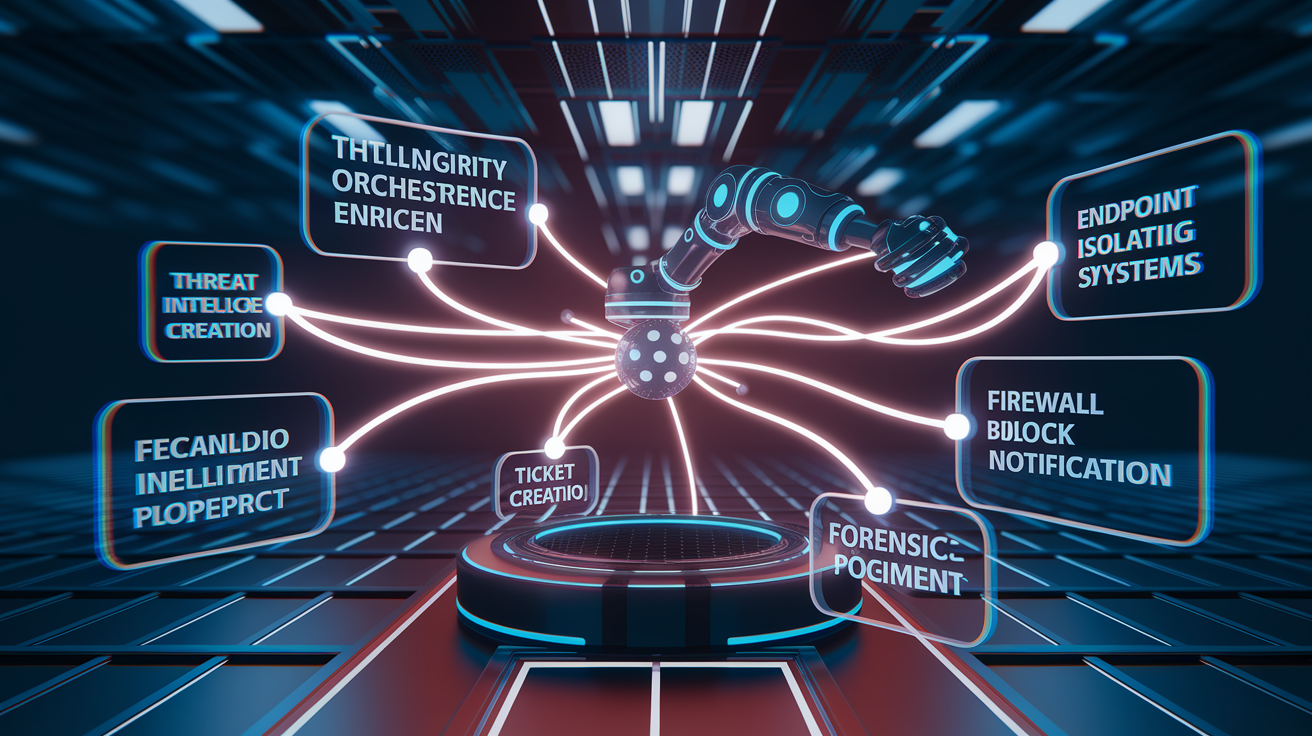
SOAR platforms automate repetitive response tasks like enriching alerts with threat intelligence, creating case tickets, and executing initial containment actions. Instead of an analyst manually looking up an IP address, checking a file hash against multiple threat feeds, and then deciding whether to isolate an endpoint, a playbook does all of that in seconds. SOAR orchestrates workflows across SIEM, EDR, firewalls, and ticketing systems, triggering actions based on predefined logic and thresholds. If an EDR alert matches high-confidence ransomware indicators, the playbook can immediately isolate the host, snapshot the disk for forensics, and notify the incident response team. All without human intervention.
Automation reduces the time attackers have to move laterally or escalate privileges. It also frees analysts from alert fatigue so they can focus on complex investigations that require judgment and creativity. Low-code playbook builders let security teams design and test workflows without deep scripting knowledge, and modern platforms support integration with hundreds of tools through APIs and pre-built connectors.
Four key benefits of automation in detection and response:
Faster triage. Automated enrichment surfaces context in seconds instead of minutes, letting analysts prioritize real threats over false positives.
Reduced manual workload. Repetitive tasks like password resets, log collection, and initial containment run without human input, cutting hours from each incident.
Consistent responses. Playbooks execute the same steps every time, eliminating variability and making sure critical actions aren’t skipped under pressure.
Improved accuracy. Automation follows documented logic and doesn’t suffer from fatigue or distraction, reducing the risk of mistakes during high-stress incidents.
Detection and Response Frameworks and Best Practices
MITRE ATT&CK is a continuously updated matrix that maps adversary tactics, techniques, and procedures across a nine-stage attack lifecycle, from initial access through impact. Security teams use ATT&CK to build detection rules that target specific behaviors (credential dumping, lateral movement via Remote Desktop Protocol, or persistence through scheduled tasks) rather than relying only on signatures. By aligning detection coverage with ATT&CK techniques, organizations can identify gaps and prioritize investments in sensors and analytics that address the most relevant threats for their environment.
NIST’s Cybersecurity Framework organizes security activities into five functions: Identify, Protect, Detect, Respond, and Recover. The Detect function emphasizes continuous monitoring, anomaly detection, and timely discovery of cybersecurity events. The Respond function covers response planning, communications, analysis, mitigation, and improvements. NIST CSF provides a common language for discussing cybersecurity maturity and helps organizations benchmark their capabilities against peers and compliance standards.
Frameworks alone don’t stop attacks. They guide the design of programs and help teams measure progress. Best practices translate framework guidance into daily operations:
Continuous monitoring. Deploy sensors across endpoints, networks, cloud workloads, and identity systems to maintain real-time visibility into all layers of the IT environment.
Regular log analysis. Schedule routine reviews of SIEM data, EDR telemetry, and NDR alerts to spot trends, tune detection rules, and catch low-and-slow attacks that don’t trigger automated alerts.
Defined escalation paths. Document who gets notified at each severity level, how quickly they must respond, and what authority they have to make containment decisions.
Documented response plans. Write playbooks for the most common scenarios (ransomware, phishing, insider threat, DDoS) and test them through tabletop exercises and simulations.
Frequent tabletop exercises. Run quarterly drills that simulate incidents, practice communication protocols, and identify gaps in tools, skills, or procedures before a real breach occurs.
Implementing a Detection and Response Program

Building an effective program starts with knowing what you’re protecting and where your current visibility ends. Many organizations discover during their first incident that they lack logs from cloud applications, can’t trace lateral movement because east-west traffic isn’t monitored, or have endpoints that don’t report to the EDR console. Asset inventory and gap assessment are the foundation. Without them, you’re deploying tools into blind spots.
Tool selection should match your threat landscape, technical environment, and team skills. A small security team managing a largely cloud-native environment will get more value from XDR and SOAR than from a complex on-premises SIEM that requires a dedicated engineer. Larger enterprises with hybrid infrastructure and regulatory obligations often need SIEM for compliance, EDR for endpoint forensics, NDR for network visibility, and SOAR to tie it all together. The right answer depends on what you’re defending against and who will operate the tools day to day.
Maturity doesn’t arrive overnight. Programs improve through iterative refinement, ongoing training, and regular performance reviews. Measure what matters (mean time to detect, mean time to respond, percentage of incidents contained within the first hour, automation rate) and use those metrics to identify bottlenecks and justify investments in additional sensors, training, or headcount.
Six steps for building or improving a detection and response program:
Inventory assets. Create a complete, continuously updated list of endpoints, servers, network devices, cloud workloads, applications, and data repositories so you know what needs protection and monitoring.
Select tools. Choose SIEM, EDR, XDR, NDR, and SOAR platforms that integrate well, fit your architecture, and match your team’s skill level and available time for tuning.
Define workflows. Document how alerts escalate, who investigates, what containment actions are authorized, and how incidents are handed off between shifts or teams.
Train staff. Invest in analyst training on tool capabilities, threat actor tactics, forensic investigation techniques, and playbook execution so your team can respond confidently under pressure.
Integrate automation. Build playbooks for common scenarios like phishing triage, malware containment, and vulnerability patching to reduce manual workload and improve response speed.
Review performance metrics. Track MTTD, MTTR, alert volume, false positive rate, and automation coverage monthly, then use those numbers to tune detection rules, refine playbooks, and prioritize next improvements.
Final Words
We covered the essentials fast: core detection concepts, major tools like SIEM/EDR/XDR/NDR, the incident response lifecycle, automation with SOAR, and frameworks that guide practice.
You saw key detection approaches—signature, behavioral analytics, anomaly detection, machine‑learning models, and real‑time triage—and how they fit different use cases.
We walked through containment, communication, playbooks, and why automation speeds triage and cuts analyst fatigue.
Use this to build practical cyber threat detection and response: start small, measure, iterate, and you’ll grow more resilient.
FAQ
Q: What is threat detection and response in cyber security?
A: The threat detection and response in cybersecurity is a set of tools and processes that find malicious activity through monitoring and analysis, then contain and remediate breaches so organizations reduce damage and recover faster.
Q: What are the 4 types of threat detection?
A: The four types of threat detection are signature-based (matches known indicators), behavioral analytics (tracks user and process patterns), anomaly detection (spots outliers from baselines), and machine-learning models (automated pattern recognition).
Q: Which is better, EDR or XDR?
A: Which is better, EDR or XDR, depends on your needs: EDR focuses on endpoints and response, while XDR correlates endpoints, network, and cloud for broader detection; choose based on scope and staffing.
Q: What are the 7 steps of incident response?
A: The seven steps of incident response are preparation, identification, containment, eradication, recovery, lessons learned, and communication/reporting, covering readiness, detection, limiting harm, restoring systems, and informing stakeholders.